When many people see a ward entrance terminal for the first time, they think it’s just an “electronic nameplate.”
But once it was actually put into use, the hospital realized that it had transformed not just the way information was displayed at ward entrances, but the entire communication system within the ward. This was especially true in the inpatient wards, where nurses’ busiest tasks each day were not the actual nursing care itself, but rather the constant repetition of confirming information and running back and forth.
A patient presses the call button, but the nurse doesn’t know exactly what the patient needs; before making rounds, doctors must first confirm the patient’s bed number; night shift nurses make repeated rounds, afraid of missing an emergency; notices in the ward are posted, then replaced, then posted again.
These issues may seem minor, but they erode nursing efficiency day by day. That is precisely why more and more hospitals are upgrading their ward management systems.
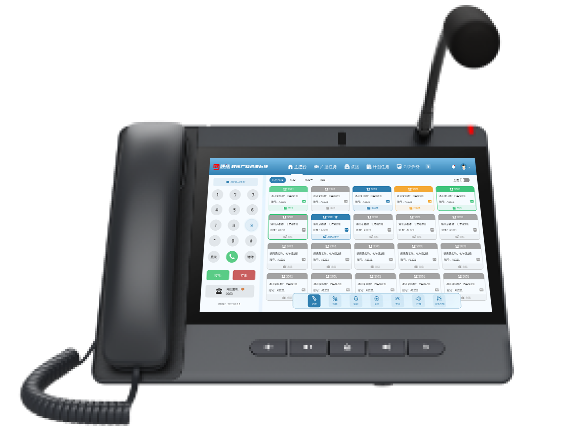
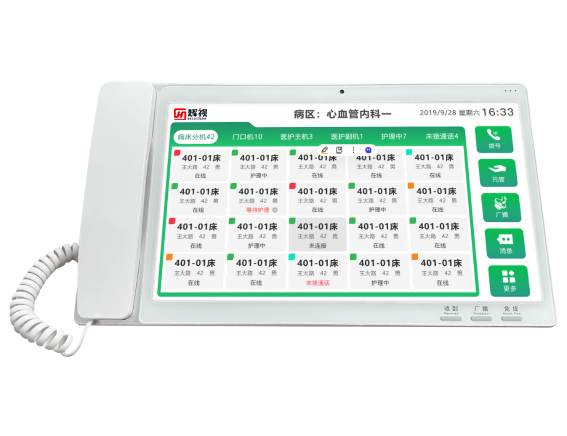
15.6-inch Smart Ward Door Station
The 15.6-inch smart ward door terminal launched by Huishi is not simply an additional screen; rather, it establishes an “information exchange platform” at the ward entrance.
In fact, many hospitals today are not lacking in systems. HIS, nurse stations, call systems, information display systems, nursing systems… they have almost all of them.
The problem, however, is that these systems operate independently of one another. The nurses’ station knows when a patient has initiated a call, but this information isn’t visible at the ward entrance; nursing care levels have been entered into the system, but they cannot be quickly identified on the floor; and while there are record-keeping requirements for rounds, these are still reliant on manual documentation.
The end result is that as the number of systems increases, nurses actually find themselves busier than ever. The ward entrance terminal consolidates previously scattered information back into the ward environment, transforming the ward entrance from a “static nameplate” into a “dynamic information hub.”
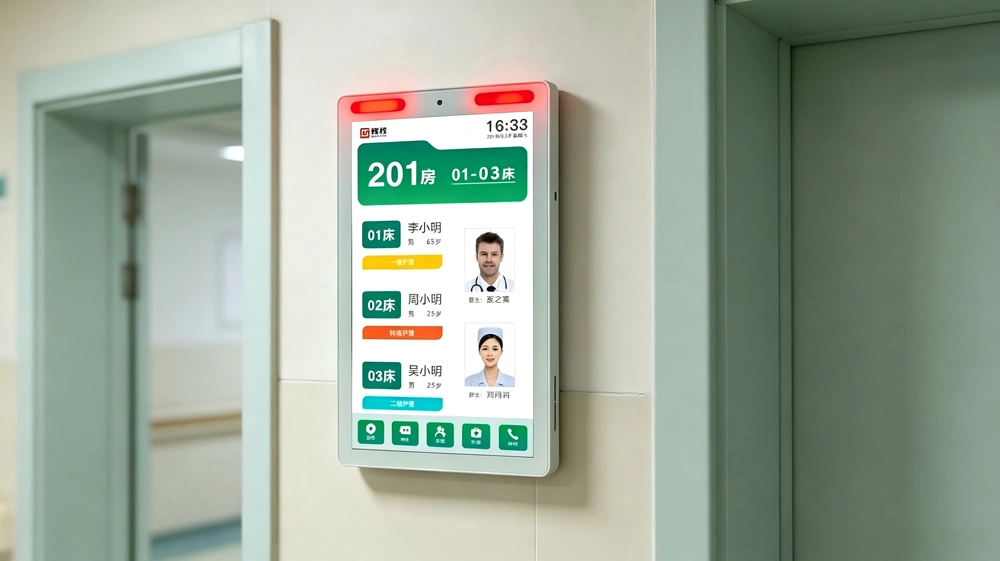
Why has the entrance to the ward become such a critical location?
Because this is a place where everyone passes through. Doctors pass through here during rounds, nurses pass through here during their rounds, patients’ family members pass through here, and support staff also pass through here.
In the past, only a single piece of paper could be displayed here; now, it can display the following in real time: • Patient information • Bed information • Care level • Healthcare staff information • Call status • Ward notices • Health education content
Healthcare staff can access information quickly without having to ask for it repeatedly or carry out multiple checks. Particularly in wards where the pace of care is fast, this ‘one less step of verification’ can actually save a great deal of time.
What nurses fear most is not being busy, but ‘missing something’
Anyone who has actually worked on a hospital project knows that, in a nursing setting, the key issue is not ‘whether a call can be made’, but ‘whether it will be missed’. This is particularly true during night shifts: if a nurse is unable to locate the patient quickly after a call has been made, delays in response are highly likely.
This 15.6-inch ward door station supports patient call alerts.
Once a patient initiates a call: • The call information is displayed in real time on the screen at the door • The three-colour door light flashes in synchronisation • Different alert levels correspond to different notification types • Emergency calls and standard calls are displayed separately
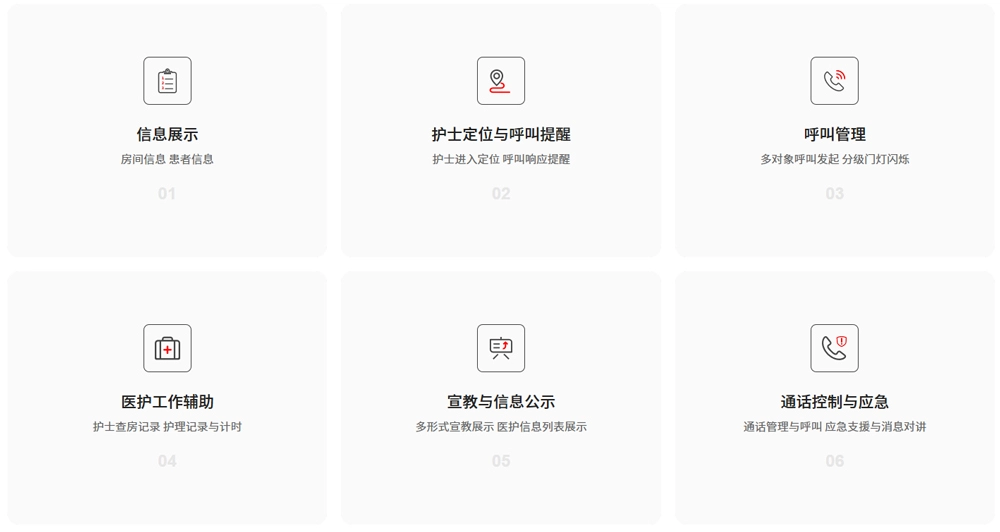
Nurses can quickly assess and prioritise tasks without having to check each ward individually. For hospitals, this improvement has a very direct impact: it reduces the amount of time nurses spend moving back and forth and improves the speed of their response.
The development of smart wards is also beginning to shift from ‘system development’ to ‘the nursing experience’.
In the past, hospital IT development focused more on back-end systems; now, an increasing number of hospitals are turning their attention to whether the patient experience is improved, whether nurses’ work is made easier, and whether ward management is more standardised.
Consequently, the development of smart wards today is no longer merely about ‘installing equipment’, but places greater emphasis on scenario-based integration.
In addition to displaying information, the ward entrance terminal also supports: • Nurse ID card recognition • Automatic ward round logging • Nursing time tracking • Call and intercom functions • One-touch support • Playback of patient education materials • Issuing ward announcements
Many tasks that were previously carried out manually can now be automated by the system. For nursing management, the greatest benefit lies in enabling nurses to devote their time to patients rather than to administrative procedures.
Given the pressures hospitals are currently facing, these extend beyond mere ‘patient intake capacity’ to include: • nursing efficiency • patient experience • management standards • digital capabilities • development of smart hospital ratings
Although the ward entrance terminal is merely a single point of access within the ward, it is in fact linked to the entire nursing process. It enables hospitals to gradually shift from a working method that previously relied on manual reminders and coordination to one where the system proactively coordinates activities. This is the true significance of smart ward development.
Show health education videos, introductions to key departments and content on hospital culture on a loop to enhance the hospital’s brand image and increase the reach of its public education initiatives.
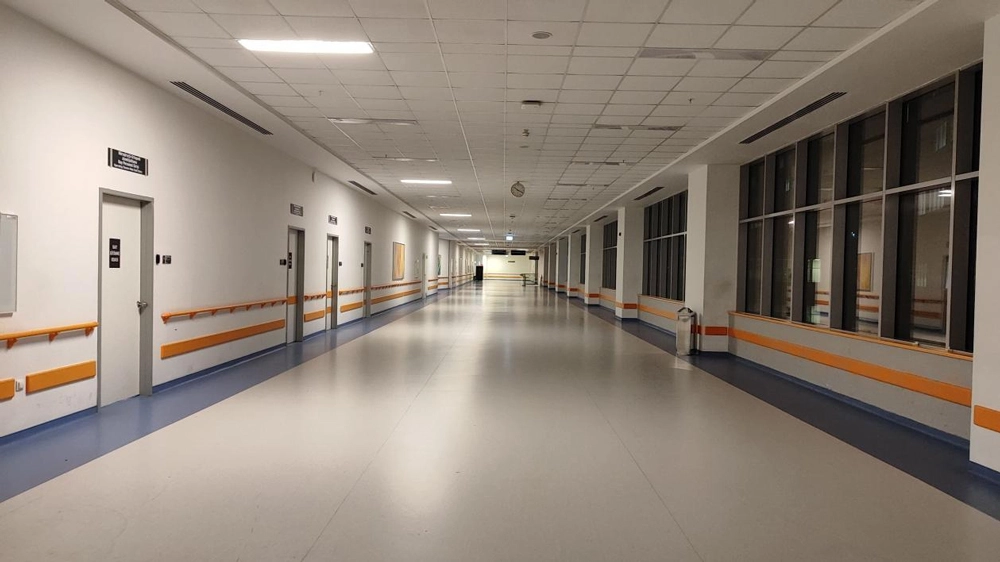
Ward management is undergoing a transformation. Whereas it used to rely on manual coordination, it now increasingly relies on digital collaboration; whereas a ward door used to be nothing more than a number, it is now becoming a key entry point to smart wards.
The Huishi 15.6-inch smart ward door station combines features such as information display, call integration, nursing reminders, nurse location tracking and health education to help hospitals improve nursing efficiency and optimise ward management, whilst also providing patients with a more timely and comfortable hospital stay.
For institutions currently advancing the development of smart hospitals, ward entrance terminals are no longer merely ‘optional equipment’, but are gradually becoming a standard feature in the development of smart wards.